Sunday, August 9, 2009

Health Insurance

Just doing my part to balance out all the crap put out by the "right" and their propaganda network (FOX News) here is a re-post from Health Beat. What happened to critical thinking in this country? This is not hard. If an insurance company is for it, you can bet it's bad for you. Thanks Maggie!

Truth Squad: The Insurance Industry Spreads Misinformation about What a Public Sector Plan Would Mean For Your Family

Claim: Recently, Karen Ignagni, president and chief executive officer of America's Health Insurance Plans (AHIP), has been trying to put the industry’s best foot forward, arguing that when it comes to reform, healthcare insurers have been the most cooperative members of the healthcare industry.

After all, insurers have agreed to stop shunning sick patients: They will no longer turn away customers who, through no fault of their own, suffer from pre-existing conditions such as breast cancer. Graciously, insurers have said that they will refrain from dropping paying customers because the insurer suddenly “discovers” a pre-existing condition --after the customer is diagnosed with MS. Finally, insurers have pledged to stop charging sicker patients sky-high premiums. Instead, everyone in a given community will pay the same premium for the same plan. (This is now the law in some states).

Truth: What the industry has agreed to hardly represents a “concession”. They have consented to do what insurance companies are supposed to do: cover not just the young and healthy, but those who might actually use the policy.

But Ignagni is right on one point: Insurers are more enthusiastic about reform than most in the healthcare industry. This is hardly surprising. Universal coverage—with a mandate that everyone buy insurance--will bring them as many as 47 million new customers, government subsidies in hand.

What’s not to like?

Granted, insurers are going to have to alter their business plan. But, without reform, the alternative was to go out of business altogether. With the cost of health care spiraling (insurers’ reimbursements have been levitating by 8 percent a year for the last ten years), employers scaling back on benefits, and more and more self-employed Americans discovering that they cannot afford to buy insurance in the individual market, for-profit insurers are in financial trouble. (If you don’t believe that, check out the price of the stocks: UnitedHealth Group, for instance, is trading at $26 and change; eighteen months ago, the company’s shares fetched $57. )


Claim: What the insurance industry is not willing to do is compete with a public insurance plan. The for-profit insurance industry wants a monopoly over all of those new customers. Of course private-sector insurers will have to vie with each other for market share, but thanks to consolidation in the industry, a few major players will be the big winners—as long as they don’t have to go head-to-head with a public sector plan. They know that the public plan would be less expensive because it won’t have to provide profits for shareholders, pay executives multi-million dollar salaries, or spend a fortune on marketing, advertising and lobbying.

While they are willing to compete with each other, they don’t want to go head-to-head with a public sector plan that would definitely cost less and, as I explain below, plans to build on Medicare reforms to offer customers higher quality care.

Claim:
Janet Trautwein, CEO of the National Association of Health Underwriters (NAHU), made this very clear earlier this week.

“We all have a stake in achieving meaningful reform that both preserves Americans' freedom to choose their doctors and lowers long-term health care costs. A public option will accomplish neither,” claimed Trautwein, who represents more than 100,000 licensed health insurance agents, brokers, consultants and benefit professionals nationwide.

Then she went out on a limb, and told what I have to call a Big Lie about the public option: "A new government-run health plan will raise costs for Americans with private insurance by systematically underpaying doctors and hospitals, our country's existing public plans -- Medicare and Medicaid--raise the average family's premiums by $1,800 a year. A public option will only exacerbate this problem--and make insurance more expensive."

Let’s break down Trautwein’s allegatins, one by one:

Claim: The NAHU supports reform that preserves our freedom to choose our doctors. A public option would not do that.

Truth: No American would be forced to choose the public option. This means that if your doctor doesn’t participate in the public plan, you could choose whatever private sector insurance he accepts. (Low-income and middle-income households that qualify for a subsidy from the government could use that subsidy to help pay for the private sector plan.).

But most likely your doctor will be part of the public plan. No doctor would be forced to sign on with the public sector option, but the majority will probably take both private sector insurance and public sector insurance—just as the vast majority now take both private insurance and Medicare. As noted below, under the House bill, both Medicare and the public sector plan will hike fees for the lowest-paid physicians.

Claim: The NAHU supports a plan that would “lower long-term costs.” The public option would not do that.

Truth: The public insurance plan would incorporate Medicare reforms (already proposed in the House legislation) that would not only trim spending but enhance the quality of care. The recommendations in the House bill encourage Medicare to realign financial incentives, rewarding providers for higher quality care, rather than volume. (If you are confused about what is actually in the House bill go to “Sustainable Middle Class” where John Freeland offers a lucid summary. Scroll down to the sections headlined: “Modernization and improvement of Medicare,” and “Innovation and delivery reform through the public health insurance option” It’s worth noting that, before he read the House bill, Freeland was not a fan of the public sector option.)

The House bill dovetails nicely with a White House proposal that an Independent Medicare Advisory Council (IMAC) set Medicare fees with an eye to paying more for services that provide the greatest benefit to the patient. Monday, White House budget director Peter Orszag’s office released a letter, signed by 13 healthcare experts--including nine members of the Congressional Budget Office’s Panel of Health Advisers endorsing the idea.

What makes this letter so interesting—and perhaps critical to the debate over reform--is that although CBO director Douglas Elmendorf has expressed reservations about whether the House bill would rein in runaway healthcare spending this group of highly-respected economists—including nearly half of CBO’s own panel of health advisers -- declared that they believe that IMAC could “reduce the rate of growth of health expenditures substantially” as long as it has “the authority to propose changes to Medicare payment rates for services whose prices do not accurately reflect value. It would also be able to recommend more general policy reforms, such as implementation of value-based purchasing [and] bundling of payments.” These initiatives, which change the way Medicare pays for services, were already included in the House bill.

When the public insurance option becomes available in 2013 it would take advantage of Medicare’s reforms. It is critical that everyone understand that the public sector insurance plan will be modeled on a new, improved version of Medicare that incorporates many of the changes that the non-partisan Medicare Payment Advisory Commission (MedPac) has been writing about for years. During the eight years of the Bush administration, these reports were ignored. Now President Obama and White House Budget director Peter Orszag as well as progressive Senators like Jay Rockefeller (D-WV) are determined to implement MedPac’s advice—counsel that focuses on doing what is best for the patient.

Claim: "A new government-run health plan will raise costs for Americans with private insurance. By systematically underpaying doctors and hospitals, our country's existing public plans--Medicare and Medicaid--raise the average family's premiums by $1,800 a year. A public option will only exacerbate this problem -- and make insurance more expensive."

Truth: First, if someone lumps Medicare and Medicaid payments together in order to suggest that Medicare underpays you can be certain that person is lying to you. Medicaid is an entirely separate program for the poor and, unlike Medicare, it is administered by the states. Medicaid pays significantly less than Medicare. The House bill addresses the problem by raising Medicaid payments for primary care to Medicare levels—but everyone agrees that Medicaid payments to specialists and hospitals remain too low.

By contrast, the idea that Medicare “systematically” pays too little just doesn’t square with the facts. Granted, there is a consensus that Medicare underpays primary care doctors and others who practice “cognitive medicine” (listening to and talking to the patient) too little. But the House bill specifically raises Medicare payments for family practitioners by 5% to 10% (paying more in areas where there are greater shortages), while also recommending bonuses for doctors who form accountable care organizations or succeed in managing chronic diseases. In addition, the House plan greatly expands scholarships and loan forgiveness for students who decide to go into primary care.

When it comes to Medicare payments to specialists and hospitals, the situation is far more complicated. Many hospitals insist that they lose money on their Medicare patients. But when the American Hospital Association testified before the Senate Finance Committee earlier this year, it acknowledged that, in 2007, 42 percent of U.S. hospitals turned a profit while serving Medicare patients.

Meanwhile, a 2006 article in the Journal on Health Care Financial Management reports that from 2002 to 2004, Medicare reimbursements for certain patients were very high—though Medicare wasn’t paying enough for patients who wound up in intensive care units (ICUs). While the cost of ICU stays rose, Medicare reimbursement shrank which translated into an average loss of $2700 for each ICU patient. Meanwhile, average Medicare reimbursement for patient not requiring an ICU stay increased by nearly 10 percent. As a result hospitals made money on these Medicare patients.

The report also revealed that just 23 percent of Medicare patients drive hospital losses, and most of these patients were admitted to an ICU. In the end when you combine the high-cost patients with the low-cost patients, 23% of the Medicare patients led to an overall loss of $387 per admission on all Medicare patients.

This suggests that, Medicare was not “systematically underpaying for all patients", though it was paying too little for ICU admissions.

The next question of course is this: why did it cost hospitals so much to care for ICU patients? On closer analysis, researchers discovered that “the pharmacy, supply, and laboratory departments accounted for more than 40 percent of the total costs” for ICU patients. “Rather than being directly related to medical services provided to the patient these areas are sources of incremental items that support patient care.”

Everyone has heard of ICU patients being subjected to a battery of tests; one wonders how many of those lab reports helped the patient? Were they all necessary? The report suggests that “hospitals need to address their costs--particularly in pharmacy, supply, and laboratory departments.”

What is certain is that across-the-board hikes—or cuts—for Medicare make little sense.

Return to the fact that not all hospitals lose money on Medicare: 42% of all U.S. hospitals manage to turn a profit on total Medicare’s reimbursements. This is something that hospitals do not like to talk about.

They know that some hospitals stay in the black when treating Medicare patients simply because they are more efficient. In private conversation, hospital CEOs have confirmed this. Medical Centers such as Mayo Clinic, and the accountable care organizations that Atul Gawande wrote about in the June 1 New Yorker provide better care at a lower cost. Meanwhile, other hospitals make a profit on the majority of their Medicare patients. They should analyze where they lose money and why. Maybe Medicare does need to increase payments for certain patients—while slicing overpayments in other areas. Or, maybe the hospital needs better system management to improve the way it delivers care.

The bottom line is this: as MedPac has pointed out in earlier reports, when private insurers pay hospitals more than Medicare does, too often, private insurers are simply rewarding inefficiency. It costs these hospitals more to care for patients because it takes them longer to make a diagnosis, or because their patients are more likely to acquire an infection, and so stay longer. Some hospitals overtreat—putting patients in an ICU who really need much less expensive—and far kinder—palliative care. Many hospitals run unnecessary tests. When private insurers pay for inefficiency and waste they pass the cost along to all of us, in the form of higher premiums.

Today or tomorrow HealthBeat will be publishing a guest-post that clarifies many of the mysteries of Medicare payment. Look for it—it’s excellent.

Tuesday, August 4, 2009

The Solution To Childhood Obesity

This worked for me! Can't really say for my mental health but I'm not a burden to the health care system, like all the fat brats that grew up to be diabetic, slovenly, slobs. I blame parents totally for this. It should be treated as child abuse. To my mom's credit, she did get me started on Atkin's when i was 14. Are you part of the problem?

http://vodpod.com/watch/1863810-untitled?pod=mightyjoe

Monday, July 20, 2009

So True

This bears a repost.

http://gubernatrix.co.uk/2009/07/how-to-be-a-better-version-of-yourself/

It is a fact of life that some people are born with unusual physical beauty, in the same way that some people are born with a talent for writing or playing the violin. Someone else’s abilities on the violin have absolutely no bearing on yours, so why should someone else’s physical appearance have any bearing on yours?

Violinist
Photo credit: Murdoch

The one thing that all the good training manuals say, but all the magazines don’t say, is that diet and training programmes must be individualised. We all start from a different basis of genetics, experience, capacity for work, personalities and lifestyles.

Magazines would prefer you to think that a celebrity’s diet or training programme can work the same way for you as it sells more magazines, but this is complete rubbish.

Some celebrities can seem to be more successful than so-called ordinary people at losing weight or getting ripped. But this is not because they are using some magic programme, this is because they are able to afford a highly individualised programme and have the energy and motivation to devote to it.

The fact is that you can also enjoy the same success if you employ these same principles: a programme designed around your needs and goals, a diet based on your lifestyle and approach to eating, plus the motivation to do it all properly – which comes from within you.

There are many ways to obtain these things. You can get expert help, by hiring a personal trainer and nutritionist. You can get support and advice by joining a diet or fitness club. You can design a diet and training programme yourself, by doing the research and teaching yourself the principles.

There are advantages and disadvantages to each route. You might think that hiring a personal trainer and nutritionist is the best route if you can afford it, but this is not necessarily the case. Learning it all yourself, while it might take longer, could be better for you in the long run. Over your lifetime, the knowledge that you have gained can be accessed for free at any time because it is in your head!

Celebrity culture

This is one of the most insidious and destructive aspects of modern (mostly) Western society. Celebrity culture can destroy people. It is vitally important that people stop wanting to look like celebrities and start wanting to look like a better version of themselves. For Christ’s sake, even celebrities don’t want to look like themselves! How many celebrities have you seen with wildly fluctuating weight, cosmetic surgery and drug use?

No-one could deny that looks are important to the majority of people but you should decide what you think looks good.

I believe it comes down to having respect for yourself as an individual. There is nothing wrong with wanting to change; in fact, this is often a very positive desire. But the focus must be on yourself and how you want yourself to look. Don’t picture a celebrity, picture a better version of yourself.

Can anyone lose weight? Yes. Can anyone put on muscle? Yes. But it may not happen in the way you think it is going to. You will learn a lot about yourself while going through the process and sometimes you will have to be realistic about your goals.

This is another reason why it is dangerous to have a celebrity as a model for your ideal look. It simply may not be possible for you to look like that. You may look great but in a different way. Always focus on the way you look.

Cutting through the crap

Not everyone wants to spend hours learning about training and nutrition in order to be able to create their own personalised programme. But you have to take responsibility for these things to a certain extent.

It is like healthy eating. You don’t have to go back to school and get a nutrition qualification but you should learn the basics and be able to make good choices when you go shopping. You must immunise yourself against marketing claims. Read the nutritional information but do not take any notice of unquantified and vague claims like “low fat” or “whole grain”, which mean nothing.

Trust your instincts. This is part of having respect for yourself and your own capacity to understand what is good and what is bad. I see people all the time getting terribly confused about what is the ‘right’ training programme or the ‘right’ type of food to eat. This is because they are desperately trying to remember what they read in a magazine or what someone told them they should be doing.

If you find yourself in this position, stop trying to remember what someone else said and try to work it out for yourself. This is not as difficult as it sounds.

Here are some simple questions to ask yourself:

  1. Are outrageous or unrealistic claims being made? Come on, you know you can’t achieve anything worthwhile in 10 minutes, right? If it was that easy, everyone would be doing it and everyone would be showing amazing results.
  2. Do the numbers add up? Often one particular number will be trumpeted, but check all the others to see if it actually makes sense. For example, 1% fat – but how much sugar? Unless it is a raw ingredient, too much of anything is likely to be suspect.
  3. Is it adaptable? Anything that is not adaptable to the individual should make you pause and consider. Very few things in life work in the same way for everyone. If adaptability is not built in, you can’t be sure it will work for you. It may be perfectly acceptable for matey over there but not for you.
  4. Is the product or service playing on your fears or uncertainties? Be suspicious of anything that plays on your fears or depicts disastrous scenarios if you don’t partake of it. This is usually marketing rubbish.
  5. Don’t assume that if something is right then everything else is wrong! This may sound unintuitive but it comes back to taking an individualised approach. For example, some people say you must eat breakfast, others say you don’t have to eat breakfast. There are scenarios where these are both right! So how do you tell the difference? Well, just be careful of absolutes. There are very few absolutes in life. If someone is telling you that you absolutely must do something, this may not be true. You are under no obligation to accept this without question just because someone chose to use strong language!
  6. Be suspicious of claims of “best” and “only”. The truth is that lots of things work. This is great news, it means that you can choose a method that works for you. Ultimately the only thing that is important is that it does work.

You’ll probably catch 90% of the crap just by going through this simple thought process.

The breakfast example

Let’s look at this more closely because it is an interesting one. If two seemingly opposite things are both right, how do you work out which is right for you?

The most thorough way would be to do a controlled experiment of both methods – but we don’t all have time to do that!

So you can take a shortcut (oh, and be suspicious of anyone who offers shortcuts!) by finding out the reasons behind the methods and deciding if those apply to you; in other words forming a hypothesis about which is more likely to be best, based on your knowledge of yourself - a topic on which you are a world expert.

In the breakfast example, the conventional wisdom is that eating a healthy breakfast is better than not because it stops you snacking and eating unhealthy food later in the day because you got hungry.

However there are also people who say it doesn’t matter what time you eat and how many times a day you eat, so long as you are eating healthy or ‘clean’ food and you are getting the right amount of calories or macronutrients in a given period of time. These people are often following an ‘intermittent fasting’ style of eating.

In each method, the desired outcome of controlling overall calories is the same and the principle of eating healthy food is the same. It is simply the tactic that is different. One tactic to avoid overeating is to eat at regular intervals, the other tactic to avoid overeating is not to eat for long periods of time.

In either case, eating unhealthy food or eating more than the required number of calories would constitute failure.

So you need to pick the tactic that you think would work for you, given your circumstances. Or try both and see which is best.

What I am saying is that there is nothing inherent in ‘breakfast’ that makes you healthier or thinner. This is why you need to find out what is behind the claims that people make. Remember, there are very few absolutes in life.

Conclusion

Serena Williams
Photo credit: burntfilm

At the risk of sounding like a self help guru I believe the key to success is: learn, aspire, believe.

If you want to be slimmer, fitter and healthier, learn about it. What else in life did you achieve without any learning? You had to learn to read, drive your car, play your sport and carry out your trade.

Aspire to be a better version of yourself, not to be someone else. Aspiration is important because true aspirations generally start with being honest about yourself. Aspiring to be better comes from an understanding of where you are now. People who have no aspirations are perhaps kidding themselves about their current situation.

Believe in your ability to cut through the crap and make decisions for yourself. Believe in your ability to carry out a programme of work and get the outcome you want. Right this moment I am watching the Williams sisters playing in the Wimbledon final and I can see right in front of me the difference made by belief. They are both brilliant tennis players – you can’t choose between them where ability is concerned. But Serena has more belief right now and she is winning.

So go on, make it happen!

Sunday, July 5, 2009

No Substitute


It's so nice to run again. There really is no substitute for this most basic of exercises. I've tried bicycling, polymetircs, and all manner of energy system training. Nothing opens my lungs up like 20 minutes of pounding the pavement. After several false starts, I think i've found the formula to prevent the knee problems i had on my previous attempts. Watching my stride and doing longer, slower intervals is the key. Instead of adhering to the Tabata, I've modified it to 30/20 or 30/30 with more sets. A little bit of running is better than a lot of almost anything else.

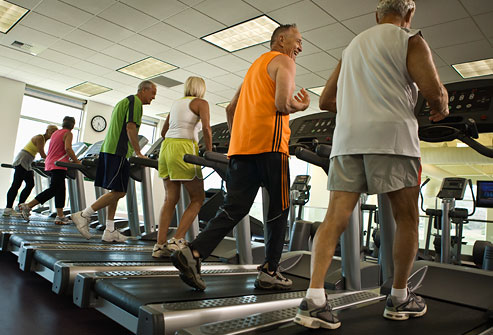
Here is a great article about the futility of treadmills and bikes from Male Pattern Fitness.

The Human Hamster Wheel: Limit Your Treadmill Time!

With his usual eloquence, Alwyn Cosgrove makes an interesting point here about treadmill running:

...steady-state cardio on the treadmill is just fucking stupid....the treadmill switches your hamstring and glutes off — your foot hits the belt and the belt pulls you through —[so] it's mainly a quad exercise.

Think of it this way: if you did 400,000 reps of triceps extensions with 100 pounds you'd get four million pounds of volume. If you didn't balance that out with biceps curls you'd expect the elbow joint to hurt, right? You're damn straight it would!

So long term walking or running on the treadmill is almost guaranteeing knee pain.

When I read this I was reminded of research that Cosgrove and others have cited about knee injuries and female athletes. The upshot is that everyone's quadriceps start out stronger than their hamstrings; over time, however, a male athlete will become less quad-dominant (disproportionately stronger in the quadriceps than the glutes and hamstrings), whereas, unless they are given specific exercises to address the imbalance, women tend to become even more quad-dominant with training. This accounts, at least in part, for the large number of ACL tears among female athletes.

Smart coaches and trainers, then, are careful to include lots of lower-body pulling exercises to address this naturally-occurring imbalance in women.

Given that treadmill-running is almost all knee extension--quadriceps work--as Cosgrove indicates, it seems like women, in particular, would be particularly well-advised to stay off the ever-popular Human Hamster Wheel, or at least make sure to balance it with exercises emphasizing hip extension: deadlift variations, step-ups and Swiss-ball leg curls; stair and hill climbing or running. Even regular-old running around outside--pick your pace--emphasizes hip-extension more than treadmill running.

Getty_rr_photo_of_seniors_on_treadmills_medium

(They won't look so happy when they get the arthroscopic surgeon's bill).

Cosgrove makes another point in the article that's worth underscoring:

...one mile on the treadmill would be 1500 reps and burn around 100 calories. If you did a circuit of kettlebell swings, undulating ropes, inverted rows, sled pushes, and burpees for four rounds with 10 to 15 reps each, you'd burn 100 calories in less time with less load, and the reps would be spread over the entire body instead of on the ankles, knees, and hips. It's just a superior model.

There's no reason why you have to stick with the same movement--such as running, rowing, or cycling, which are, in essence, low-level resistance exercises--for the duration of your conditioning session: in fact, it doesn't make a lot of sense. If your intention is to burn calories, it seems much smarter to do as Cosgrove suggests, mixing it up with several difference exercises, loading different parts of the body, creating a balanced workout and avoiding excessive strain on any one area.

In my experience, both as an athlete and trainer, exercises which train the upper body and lower body together (thrusters, clean and jerks, burpees, step-up-and-presses, lunge and curl) are, metabolically speaking, about as tough as you can get. The body seems to go into high alert, as oxygen demand skyrockets from virtually every muscle, head to toe. Only slightly less demanding are compound sets of movements for the upper and lower body--something like the circuit described by Cosgrove above.

It takes some time to work up to training with this kind of intensity, but once you're capable of it, it seems like about the most efficient option for fat loss--not to mention safer and more fun.

Friday, July 3, 2009

Edocine Disruptors

Another thing I have been talking about for the last 10 years. This gentleman was on The Daily Show evening.


It’s Time to Learn From Frogs

Some of the first eerie signs of a potential health catastrophe came as bizarre deformities in water animals, often in their sexual organs.

Frogs, salamanders and other amphibians began to sprout extra legs. In heavily polluted Lake Apopka, one of the largest lakes in Florida, male alligators developed stunted genitals.

In the Potomac watershed near Washington, male smallmouth bass have rapidly transformed into “intersex fish” that display female characteristics. This was discovered only in 2003, but the latest survey found that more than 80 percent of the male smallmouth bass in the Potomac are producing eggs.

Now scientists are connecting the dots with evidence of increasing abnormalities among humans, particularly large increases in numbers of genital deformities among newborn boys. For example, up to 7 percent of boys are now born with undescended testicles, although this often self-corrects over time. And up to 1 percent of boys in the United States are now born with hypospadias, in which the urethra exits the penis improperly, such as at the base rather than the tip.

Apprehension is growing among many scientists that the cause of all this may be a class of chemicals called endocrine disruptors. They are very widely used in agriculture, industry and consumer products. Some also enter the water supply when estrogens in human urine — compounded when a woman is on the pill — pass through sewage systems and then through water treatment plants.

These endocrine disruptors have complex effects on the human body, particularly during fetal development of males.

“A lot of these compounds act as weak estrogen, so that’s why developing males — whether smallmouth bass or humans — tend to be more sensitive,” said Robert Lawrence, a professor of environmental health sciences at the Johns Hopkins Bloomberg School of Public Health. “It’s scary, very scary.”

The scientific case is still far from proven, as chemical companies emphasize, and the uncertainties for humans are vast. But there is accumulating evidence that male sperm count is dropping and that genital abnormalities in newborn boys are increasing. Some studies show correlations between these abnormalities and mothers who have greater exposure to these chemicals during pregnancy, through everything from hair spray to the water they drink.

Endocrine disruptors also affect females. It is now well established that DES, a synthetic estrogen given to many pregnant women from the 1930s to the 1970s to prevent miscarriages, caused abnormalities in the children. They seemed fine at birth, but girls born to those women have been more likely to develop misshaped sexual organs and cancer.

There is also some evidence from both humans and monkeys that endometriosis, a gynecological disorder, is linked to exposure to endocrine disruptors. Researchers also suspect that the disruptors can cause early puberty in girls.

A rush of new research has also tied endocrine disruptors to obesity, insulin resistance and diabetes, in both animals and humans. For example, mice exposed in utero even to low doses of endocrine disruptors appear normal at first but develop excess abdominal body fat as adults.

Among some scientists, there is real apprehension at the new findings — nothing is more terrifying than reading The Journal of Pediatric Urology — but there hasn’t been much public notice or government action.

This month, the Endocrine Society, an organization of scientists specializing in this field, issued a landmark 50-page statement. It should be a wake-up call.

“We present the evidence that endocrine disruptors have effects on male and female reproduction, breast development and cancer, prostate cancer, neuroendocrinology, thyroid, metabolism and obesity, and cardiovascular endocrinology,” the society declared.

“The rise in the incidence in obesity,” it added, “matches the rise in the use and distribution of industrial chemicals that may be playing a role in generation of obesity.”

The Environmental Protection Agency is moving toward screening endocrine disrupting chemicals, but at a glacial pace. For now, these chemicals continue to be widely used in agricultural pesticides and industrial compounds. Everybody is exposed.

“We should be concerned,” said Dr. Ted Schettler of the Science and Environmental Health Network. “This can influence brain development, sperm counts or susceptibility to cancer, even where the animal at birth seems perfectly normal.”

The most notorious example of water pollution occurred in 1969, when the Cuyahoga River in Ohio caught fire and helped shock America into adopting the Clean Water Act. Since then, complacency has taken hold.

Those deformed frogs and intersex fish — not to mention the growing number of deformities in newborn boys — should jolt us once again.

http://www.nytimes.com/2009/06/28/opinion/28kristof.html?_r=1&pagewanted=print

Monday, June 29, 2009

The doctor is in

Dr. McGill is a very smart man. All of these exercises are recommended by me. Stiring the pot can be extrapolated to the barbell in a corner for more real life motor neural integration.

http://well.blogs.nytimes.com/2009/06/17/core-myths/?em

Is Your Ab Workout Hurting Your Back?

Phys Ed
core exerciseGetty Images

The genesis of much of the ab work we do these days probably lies in the work done in an Australian physiotherapy lab during the mid-1990s. Researchers there, hoping to elucidate the underlying cause of back pain, attached electrodes to people’s midsections and directed them to rapidly raise and lower their arms, like the alarmist robot in “Lost in Space.”

In those with healthy backs, the scientists found, a deep abdominal muscle tensed several milliseconds before the arms rose. The brain apparently alerted the muscle, the transversus abdominis, to brace the spine in advance of movement. In those with back pain, however, the transversus abdominis didn’t fire early. The spine wasn’t ready for the flailing. It wobbled and ached. Perhaps, the researchers theorized, increasing abdominal strength could ease back pain. The lab worked with patients in pain to isolate and strengthen that particular deep muscle, in part by sucking in their guts during exercises. The results, though mixed, showed some promise against sore backs.

From that highly technical foray into rehabilitative medicine, a booming industry of fitness classes was born. “The idea leaked” into gyms and Pilates classes that core health was “all about the transversus abdominis,” Thomas Nesser, an associate professor of physical education at Indiana State University who has studied core fitness, told me recently. Personal trainers began directing clients to pull in their belly buttons during crunches on Swiss balls or to press their backs against the floor during sit-ups, deeply hollowing their stomachs, then curl up one spinal segment at a time. “People are now spending hours trying to strengthen” their deep ab muscles, Nesser said.

But there’s growing dissent among sports scientists about whether all of this attention to the deep abdominal muscles actually gives you a more powerful core and a stronger back and whether it’s even safe. A provocative article published in the The British Journal of Sports Medicine last year asserted that some of the key findings from the first Australian study of back pain might be wrong. Moreover, even if they were true for some people in pain, the results might not apply to the generally healthy and fit, whose trunk muscles weren’t misfiring in the first place.

“There’s so much mythology out there about the core,” maintains Stuart McGill, a highly regarded professor of spine biomechanics at the University of Waterloo in Canada and a back-pain clinician who has been crusading against ab exercises that require hollowing your belly. “The idea has reached trainers and through them the public that the core means only the abs. There’s no science behind that idea.” (McGill’s website is backfitpro.com.)

The “core” remains a somewhat nebulous concept; but most researchers consider it the corset of muscles and connective tissue that encircle and hold the spine in place. If your core is stable, your spine remains upright while your body swivels around it. But, McGill says, the muscles forming the core must be balanced to allow the spine to bear large loads. If you concentrate on strengthening only one set of muscles within the core, you can destabilize your spine by pulling it out of alignment. Think of the spine as a fishing rod supported by muscular guy wires. If all of the wires are tensed equally, the rod stays straight. “If you pull the wires closer to the spine,” McGill says, as you do when you pull in your stomach while trying to isolate the transversus abdominis, “what happens?” The rod buckles. So, too, he said, can your spine if you overly focus on the deep abdominal muscles. “In research at our lab,” he went on to say, “the amount of load that the spine can bear without injury was greatly reduced when subjects pulled in their belly buttons” during crunches and other exercises.

Instead, he suggests, a core exercise program should emphasize all of the major muscles that girdle the spine, including but not concentrating on the abs. Side plank (lie on your side and raise your upper body) and the “bird dog” (in which, from all fours, you raise an alternate arm and leg) exercise the important muscles embedded along the back and sides of the core. As for the abdominals, no sit-ups, McGill said; they place devastating loads on the disks. An approved crunch begins with you lying down, one knee bent, and hands positioned beneath your lower back for support. “Do not hollow your stomach or press your back against the floor,” McGill says. Gently lift your head and shoulders, hold briefly and relax back down. These three exercises, done regularly, McGill said, can provide well-rounded, thorough core stability. And they avoid the pitfalls of the all-abs core routine. “I see too many people,” McGill told me with a sigh, “who have six-pack abs and a ruined back.”

Saturday, June 27, 2009

But = Bullshit

I miss working out and being in shape but (bullshit) between the job and the kids, I just don't have time.

Friday, June 26, 2009

Straight Arm Dumbell Row

I think this long forgotten little gem may have fixed my Lat/Serratus problem. Kudos to Christian Thibaudeau over at T-nation. I used to do these all the time as they are great to get you in touch with your Lats.

Another hat tip to Marybeth over at Somaquest for reminding me that its about intention.


Dumbbell row (straight-arm)

This exercise is very good at developing the lats. The objective is to bring the arm up and back while keeping it relatively straight. Really concentrate on your lats while doing this drill; don't use a lot of weight as it's not needed to get the most out of this drill. It's more important to focus on maintaining maximum back tension during every inch of every rep.

Thursday, June 25, 2009

SOCIAL NETWORKS AND HAPPINESS

Surround yourself with "happy people". I think we have all sensed this as true.

SOCIAL NETWORKS AND HAPPINESS

Happiness is a fundamental object of human existence. To the extent that it is synonymous with pleasure, it could even be said to be one of the \"two sovereign masters\" that, Jeremy Bentham argued, govern our lives. The other master, lest we forget, is pain.

Our happiness is determined by a complex set of voluntary and involuntary factors, ranging from our genes to our health to our wealth. Alas, one determinant of our own happiness that has not received the attention it deserves is the happiness of others. Yet we know that emotions can spread over short periods of time from person to person, in a process known as \"emotional contagion.\" If someone smiles at you, it is instinctive to smile back. If your partner or roommate is depressed, it is common for you to become depressed.

But might emotions spread more widely than this in social networks—from person to person to person, and beyond? Might an individual\'s location within a social network influence their future happiness? And might social network processes—by a diverse set of mechanisms—influence happiness not just fleetingly, but also over longer periods of time?

We recently published a paper in the British Medical Journal that addressed these questions. We studied 4,739 people followed from 1983 to 2003 as part of the famous Framingham Heart Study. These individuals were embedded in a larger network of 12,067 people; they had an average of 11 connections to others in the social network (including to friends, family, co-workers, and neighbors); and their happiness was assessed every few years using a standard measure.

We found that social networks have clusters of happy and unhappy people within them that reach out to three degrees of separation. A person\'s happiness is related to the happiness of their friends, their friends\' friends, and their friends\' friends\' friends—that is, to people well beyond their social horizon. We found that happy people tend to be located in the center of their social networks and to be located in large clusters of other happy people. And we found that each additional happy friend increases a person\'s probability of being happy by about 9%. For comparison, having an extra $5,000 in income (in 1984 dollars) increased the probability of being happy by about 2%.

Happiness, in short, is not merely a function of personal experience, but also is a property of groups. Emotions are a collective phenomenon.

To follow up this study, we have also been examining online social networks. Emotional clustering and contagion are so fundamentally rooted in our ancient evolutionary psychology that—we believe—they should carry over to the very modern online world of email, blogs, and social networking sites like MySpace and Facebook.

One of our efforts has involved the examination of a group of 1,700 college students who are interconnected in Facebook. We examined these students\' online profiles. We noted who their friends were and we also studied their photographs.

The photographs were valuable in two ways. First, we coded who appeared in photographs with whom. People who take the trouble to be in the same place, take a photograph together, upload the photograph, and label (\"tag\") it, almost certainly have a closer relationship with one another than the usual \"friends\" people indicate in online social networking sites. In fact, while the average student in our data had over 110 friends on Facebook, they had an average of only six \"picture friends\" (i.e., people close enough that they tagged the student).

Second, we coded whether the students were smiling in their profile photographs, and we mapped the network of students and their picture friends, making note of who was smiling and who was not. In a way, this is the online analogue of the research we did with happiness in the Framingham social network, though smiling is, of course, different than happiness.

The figure below is a map of part of this Facebook network in 2007. It contains 353 students, each represented by a node; each line between two nodes indicates that the connected individuals were tagged in a photo together. Students who are smiling (and who are immediately surrounded by smiling people in their network) are colored yellow. Students who are frowning (and who are immediately surrounded by such serious looks) are colored blue. Shades of green indicate a mix of smiling and non-smiling friends.

Notice how strongly the blue nodes and the yellow nodes cluster together, indicating large-scale structure of smiling in the online network. Moreover, people who do not smile seem to be located more peripherally in the network. In fact, statistical analysis of the network shows that people who smile tend to have more friends (smiling gets you an average of one extra friend, which is pretty good considering that people only have about six close friends). Not only that, but the statistical analyses confirm that those who smile are measurably more central to the network compared to those who do not smile. That is, if you smile, you are less likely to be on the periphery of the online world.

It thus seems to be the case, online as well as offline, that when you smile, the world smiles with you.


[click on image to enlarge]

Wednesday, June 24, 2009

Narcissism

I'm always self editing to check for this problem. It all comes back to the question of value. Why do you train? Is it only for the praise of others? Would you continue to train on a desert island? Training for me is a Zen thing. I do it because I love IT.

ThatsFit.ca - Food, Relationships, Health, Fitness and Beauty


Sunday, June 21, 2009

Food, Inc.

So your diabetic, unemployed, have no health insurance and you voted for Bush? Really? He's a guy I could have a beer with. Way to go there fatso.

Julie's Health Club - Where alternative and mainstream health meet | Chicago Tribune | Blog | Blogroll
Food, Inc.: How factory farming affects you

Important food for thought

Multimedia_gallery-image[1] The sobering new documentary Food, Inc. which opens in Chicago on June 19, shows the enormous hidden costs we all pay for eating cheap, factory-farmed food.

Most of us don't think much about how the food on grocery store shelves is produced, what's in it, or the impact it has on our bodies, the planet or the laborers.

And that's exactly how big agribusiness likes it, according to director Robert Kenner, who set out to "lift the veil" on the industrial food process.

Though the film is admittedly one-sided--Monsanto, Tyson, Perdue and Smithfield all declined the filmmakers access and prevented some of their growers from talking on camera--there's enough shocking undercover camera footage to make viewers start asking some important questions, such as "where does our food come from?"

Interviews with intestigative reporters and authors Eric Schlosser, ("Fast Food Nation") and Michael Pollan ("The Omnivore's Dilemma), independent farmers such as Joel Salatin (pictured above) and others, meanwhile, add context and help connect the dots.


But despite the factory-farm scenes, some of the most thought-provoking moments were these statements that were spoken or flashed on the screen. According to the filmmakers:

*

In 1972, the U.S. Food and Drug Administration conducted 50,000 food safety inspections. In 2006, the FDA conducted only 9,164.

*

In 1996 when it introduced Round-Up Ready soybeans, Monsanto controlled only 2 percent of the U.S. soybean market. Now, over 90 percent of soybeans in the U.S. contain Monsanto's patented gene.
*

Supreme Court Justice Clarence Thomas was an attorney at Monsanto from 1976 to 1979. After his appointment to the Supreme Court, Justice Thomas wrote the majority opinion in a case that helped Monsanto enforce its seed patents.
*

70 percent of processed foods have some genetically modified ingredient. (Genetically modified crops are not labeled in the U.S. even though 90 percent of consumers have said they want labeling.)
*

1 in 3 Americans born after 2000 will contract early onset diabetes; Among minorities, the rate will be 1 in 2.

Listen to: Michael Pollan discuss the film with NPR's Steve Inskeep.

Read: "Why Bother?" by Michael Pollan.

Read: Patrick Goldstein's review in the Los Angeles Times

Read: 10 ways you can change your eating habits.


Saturday, June 20, 2009

TMUSCLE.com | Advice You Don't Want to Hear Vol 2

Mike Robertson: Your Upper Back Strength Sucks

If most people trained their upper back as hard as they should, we\'d have a lot fewer geek physiques and jacked-up shoulders roaming around the local fitness facility.

If you\'re looking for an analogy, upper back is like the leg workout for your upper body. If you\'re serious and pushing yourself, it\'s a damn hard workout.

Think about it like this: Are you always willing to do that extra chin-up? Or to add another five pounds to your chest-supported row? If you\'re like most guys and gals out there, the answer is probably \"no.\"

The cool thing is, when you get serious about your upper back strength, everything seems to get bigger and stronger. Without even trying, you\'re adding mass to your arms. Your squat and your deadlift are suddenly much more stable.

And your bench press? Well, I\'d bet that your bench would really shoot through the roof if you trained your back — the stabilizers of your bench press — as hard as you trained the bench press itself.

If you want to take your back strength and development to the next level, try prioritizing it in your training for several months. Increase the volume. Place a big exercise like chins or chest-supported rows first in your workout. Better yet, place them at the beginning of your workout and at the beginning of your training week.

Get serious about your upper back. You\'ll be amazed at the results.

Tuesday, June 9, 2009

SomaQuest

I found this fascinating quote today:


Just as you forget what's in the junk drawer until you need something in there, and rediscover it again, certain aspects of ourselves get "filed away" because of disuse, confusion, or experience. "I'll need this someday," we tell ourselves. It's in a crisis -- where is the allen wrench? Didn't I have a crochet hook? -- that we frantically search for the perfect, simple, and elusive tool that solves our problem. Likewise, the experience of a freely floating shoulder, an easy neck, or a flexible and buoyant spine gets "filed away" after years of sitting still in a school desk or before a computer screen. The gentle and pleasurable movements we experienced as children are "filed away" in our brains, waiting to be rediscovered. When your neck feels tight, you know you should relax or release -- but how do you do that? If you knew how, you'd have done it long ago. This information is in the junk drawer.MaryBeth Smith, SomaQuest, Jun 2009


You should read the whole article.


This gets my mental gears rolling. It just a matter of remembering how to move and be pain free. At least it's a start.

TMUSCLE.com | Training Tips From A to Z

Can I get an AMEN!

L is for Let\'s Be Honest, We\'re Wussies

You can always train around an injury.

If you have chronic lower-back pain, you can work on core stability. If you have shoulder impingement, you can cut back on bench presses while adding more horizontal rowing (not to mention the fact you have a lower body that isn\'t affected). Knee pain won\'t stop you from performing glute-ham raises until your ass has its own zip code.

That is, if you really want to train.

Eric Cressey and I have worked with clients who came to us on crutches, in back braces, or with limbs in a cast. We could always find ways to give them a good workout without interfering with their rehab. Sometimes they actually get stronger.

Conversely, there are people who\'ll skip out on a training session because they\'re tired or have a headache. We call them \"wussies.\" Next time you feel like being one, watch this video.

Sunday, June 7, 2009

The Jammer


The Hammer Strength Jammer is an awesome "machine". Having eschewed bench presses and anything that impinges the shoulder, I rediscovered the Jammer at Red's. Now they won't list the price on their web site so you know it's out of this world. Making do one day with what I had, I came up with the old "bar in a corner" stand by. Old school rules.

Monday, June 1, 2009

Bizzaro

http://www.liftgymdesign.com/

The opposite universe. I must say that if i win the lottery this is the home gym for me.

Yes, I am jealous.

How do I work my butt?


If I had a nickle for every time I've heard this question I would be rich. And to avoid the obvious answer "get off of it", Leg curls on a stability ball are an excellent option. Squats, deadlifts, and lunges being the top ones of course. If injury, lack of equipment, or another medical condition prevent those, try these.

Sunday, May 24, 2009

ART and MUA

I have been to several new Doctors trying to get my rib condition fixed and I may have done it. Between Jeff and Brian, and Alice, we just about have this licked. If you travel between Lafayette and Houston and need some therapy then look no further than these fine professionals.

http://www.cajunspine.com/Home.html

http://plenmuainstitute.com/index.html

I'm actually considering getting back into massage and getting ART certified.